Introvert vs. Social Anxiety: Decoding the Silent Power and the Hidden Barrier
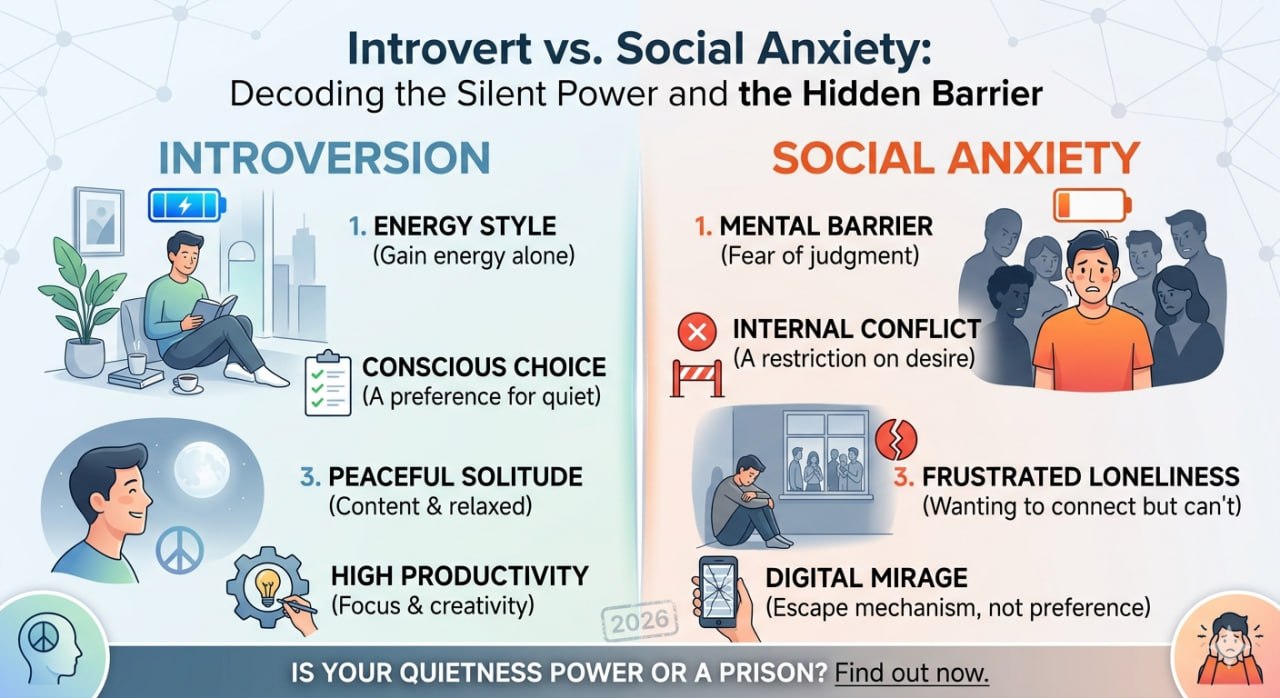
In a world that often values the "loudest voice in the room," being quiet is frequently misunderstood. Many individuals who prefer solitude are labeled as having "social anxiety," while those struggling with deep-seated fears are told they are "just introverts."
However, the distinction is vital. One is a biological personality trait (Introversion); the other is a treatable mental health condition (Social Anxiety). Understanding which one applies to you is the first step toward self-acceptance.
1. Introversion: A Matter of Biological Wiring
Introversion is not about being "broken" or "shy." According to the Big Five personality model, it is a preference for low-stimulation environments.
- The Dopamine Factor: Research suggests introverts may be more sensitive to dopamine. While extroverts need more social "hits" to feel good, introverts feel overstimulated quickly.
- The Recharge Mechanism: Think of an introvert like a high-performance battery. Socializing—even with people they love—drains that battery. They require solitude to return to their baseline.
- A Power of Choice: An introvert skips a party because they value their alone time, not because they fear the people at the party.
2. Social Anxiety: The Barrier of "What If?"
Social Anxiety Disorder (SAD) is rooted in the Fear of Negative Evaluation. It isn't a preference; it’s a restriction.
- The Internal Conflict: A socially anxious person may actually be an extrovert. They might crave connection but are paralyzed by the fear of being judged, embarrassed, or rejected.
- Physical Symptoms: Unlike introversion, social anxiety symptoms often manifest physically—sweating, racing heart, or "blanking out" during conversations.
- The Safety Loop: While an introvert feels refreshed after being alone, a person with social anxiety feels "safe" but often remains lonely and frustrated.
3. The 2026 Perspective: The "Digital Ghost" Trend
In the current digital age, the line is blurring. Many people use "introversion" as a label to justify digital avoidance. If your "me-time" consists solely of scrolling to avoid the real world, you might be dealing with social avoidance rather than true introversion. True introversion is productive and restorative; avoidance is a defense mechanism. This can sometimes lead to digital addiction in our increasingly creative world.
Caption: Woman enjoying coffee alone (Introversion) vs Man sweating in meeting (Social Anxiety).
4. Moving Forward: Strategy for Both
- For the Introvert: Own your space. Don't apologize for needing to leave early. Your deep-thinking ability is a professional superpower.
- For the Socially Anxious: Consider Cognitive Behavioral Therapy (CBT) or gradual Exposure Therapy. Unlike introversion, which is a permanent part of your "OS," anxiety is a "software bug" that can be patched.
Strategic Backlinks & References
To boost your SEO authority, we've included links to high-authority domains and internal content:
- Scientific Definition: NAMI
- Personality Theory: Psychology Today
- Self-Assessment: Mayo Clinic
- Internal Knowledge: Explore our take on the latest digital trends at akhilprakash.live.
Subscribe to the newsletter
Get the latest posts delivered right to your inbox.