The Strait of Hormuz: The Narrow Waterway Holding the World Hostage
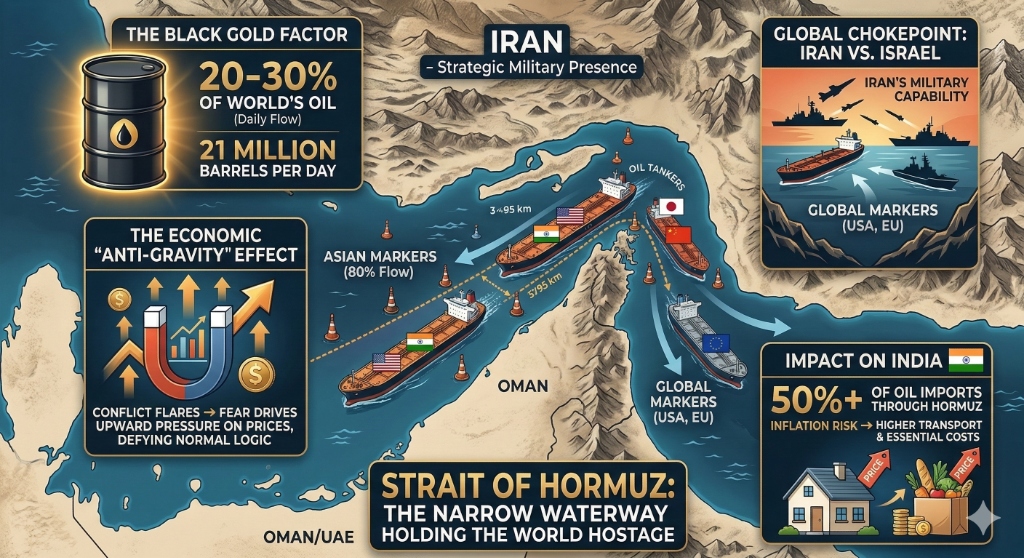
When tensions rise between Iran and Israel, one name dominates the headlines: The Strait of Hormuz. This tiny strip of water, measuring between 33km and 95km in width, is the "jugular vein" of the global economy. If this passage closes, the impact would be felt from the boardrooms of Wall Street to the kitchen budgets of everyday families.
What is the Strait of Hormuz?
The Strait of Hormuz is a strategically vital waterway connecting the Persian Gulf with the Gulf of Oman and the Arabian Sea. It serves as the natural border between Iran on one side and the Arabian Peninsula (specifically Oman and the UAE) on the other.
While the strait itself is miles wide, the actual shipping lane safe for massive tankers is incredibly narrow—only about 3 kilometers wide in each direction. Imagine the world’s largest oil tankers having to squeeze through a passage no wider than a city neighborhood.
Why the World Fears a Shutdown: The "Black Gold" Factor
The global obsession with this strait comes down to one thing: Oil.
- Massive Volume: Approximately 20% of the world’s total oil consumption passes through this strait daily.
- Daily Flow: Roughly 20–21 million barrels of crude oil from Saudi Arabia, Iraq, Kuwait, and the UAE must cross this point to reach global markets.
- Energy Beyond Oil: It is also the primary exit route for Qatar’s Liquefied Natural Gas (LNG) supplies.
If this supply chain is disrupted, it would cause severe disruption and sharp price increases in the global energy market.
The Geopolitical Chessboard: Iran vs. The World
Under the 1982 UN Convention on the Law of the Sea, all nations have the right of "transit passage." However, because the shipping lanes fall within the territorial waters of Iran and Oman, Iran frequently uses the strait as a bargaining chip.
Iran has often threatened to close the strait if faced with severe sanctions or military threats. While they can easily harass large tankers using fast-attack boats and coastal missiles, completely blocking the strait would be extremely difficult due to the constant international naval presence.
The "Anti-Gravity" of Global Economics
In physics, gravity pulls things together; in economics, the Strait of Hormuz acts as a form of "Economic Anti-Gravity." When conflict flares up here, it pushes market stability away. It creates an upward pressure on prices that defies normal market logic. A single "spark" or minor skirmish in the strait can cause oil prices to "levitate" overnight. This "Anti-Gravity" effect means that even if a country doesn't buy oil directly from the Middle East, the global price hike will still hit them.
Impact on India and Asia
The stakes are highest for Asian markets, which receive over 80% of the oil passing through the strait.
- Energy Dependency: India imports over 80% of its crude oil, with more than half coming through Hormuz.
- Inflation: If Iran closes the path, oil prices skyrocket. This leads to higher transport costs, which directly increases the price of vegetables, milk, and daily essentials.
FAQ
What is the Strait of Hormuz? The Strait of Hormuz is a narrow waterway connecting the Persian Gulf to the Gulf of Oman and is one of the most important oil transit routes in the world.
Why is the Strait of Hormuz important? Nearly 20% of global oil supply passes through the strait, making it critical for global energy security.
Can Iran close the Strait of Hormuz? Iran has threatened to close the strait during geopolitical tensions, but completely blocking it would be extremely difficult due to international naval presence.
Conclusion
The Strait of Hormuz is a volatile reminder of how fragile our global systems are. While countries like Saudi Arabia and the UAE have built pipelines to bypass the strait, their capacity is limited. For now, the world remains tethered to this narrow passage.
Peace in the Middle East isn't just a humanitarian goal—it is a requirement for global financial survival.
Further Reading
Subscribe to the newsletter
Get the latest posts delivered right to your inbox.